
Preventable Emergency Visits Tip Sheet
Measure Description
The rate of preventable emergency department (ED) visits per 1,000 members per year. This measure is derived from the Statewide Collaborative Quality Improvement Project: Reducing Avoidable Emergency Room Visits.
Note: This is an inverse measure; a lower rate of preventable ED visits qualifies for more CBI points.
Incentives are paid to the linked primary care provider (PCP) on an annual basis, following the end of quarter four. For additional information, refer to the CBI Technical Specifications.
- Administrative members at date of service.
- Dual coverage members.
- ED visits that result in inpatient admissions.
- Members less than one year old at date of service.
- California Children’s Services (CCS) members.
Members are frequently seen at the ED for screening services and general examinations. Below is a list of common preventable ED diagnoses derived from the Statewide Collaborative Quality Improvement Project: Reducing Avoidable Emergency Room Visits:
- Acute bronchitis, nasopharyngitis, upper respiratory infection, pharyngitis
- Sore mouth or throat (e.g., thrush, tonsillitis), ear infections
- Allergies, sinusitis, conjunctivitis
- Back pain
- Headache
- Skin problems/infections (scabies, miliaria, tinea corporis)
- Urinary tract infection
- Vaginitis
For a full list of preventable diagnoses, refer to the Preventable Emergency Visit Diagnoses Tip Sheet on the website and the CBI Technical Specifications.
Data for this measure is collected using claims.
- Educate members to always call the PCP office for an appointment before going to the ED.
- Monitor the Linked Member ED Visit report in the Provider Portal to track linked members who were recently seen in the ED, as well as the Linked Member High ED Utilizers report for members seen in the ED three or more times within a 90-day period. There may be members who are assigned and never seen to whom you can provide additional outreach.
- Contact members seen for preventable ED visits and bring them in for follow-up.
- Review day-of-the-week trends and open additional appointment times based on trends.
- Look at your third next available appointment times. If appointments are too far out, patients are more likely to use the ED.
- Orient all new members on your office hours, how to reach you after hours and what conditions you will see urgently.
- Identify high utilizers of the ED and bring them in to review their problem list.
- Alliance Cultural and Linguistic Services are available to network providers.
- Language Assistance Services – Request materials at 800-700-3874, ext. 5504.
- Telephonic Interpreter Service – Directly access a telephonic interpreter 24 hours a day, 7 days a week.
- Interpreter Services – Can be requested for the appointment with the member.
- Virtual Remote Interpreter (VRI) Service – When an in-person interpreter might not be available or easy to access.
- For information about the Cultural and Linguistic Services Program, call the Alliance Health Education Line at 800-700-3874, ext. 5580 or email us at [email protected].
- Alliance Enhanced Care Management (ECM) and Community Supports.
- Refer Alliance members through the Alliance Provider Portal, email [email protected], mail or fax, or by phone at 831-430-5512.
- For Complex Care Management and Care Coordination, call the Care Management team at 800-700-3874 (TTY: Dial 711).
- Alliance Nurse Advice Line to talk to a nurse.
- 844-971-8907 (TTY: Dial 711).
- Educate all members to use the Alliance Nurse Advice Line that is available to all Alliance members 24 hours a day, 7 days a week to discuss health concerns to avoid hospital readmissions and preventable emergency visits.
- Add to your phone-tree and route after-hours calls from Alliance members.
- Alliance Transportation Services for patients with transportation challenges.
- For non-emergency medical transportation (NEMT) services, call 800-700-3874, ext. 5640 (TTY: Dial 711).
- For non-medical transportation (NMT) services, call 800-700-3874, ext. 5577 (TTY: Dial 711).
- Impacting Use of the Emergency Department Physician Toolkit.
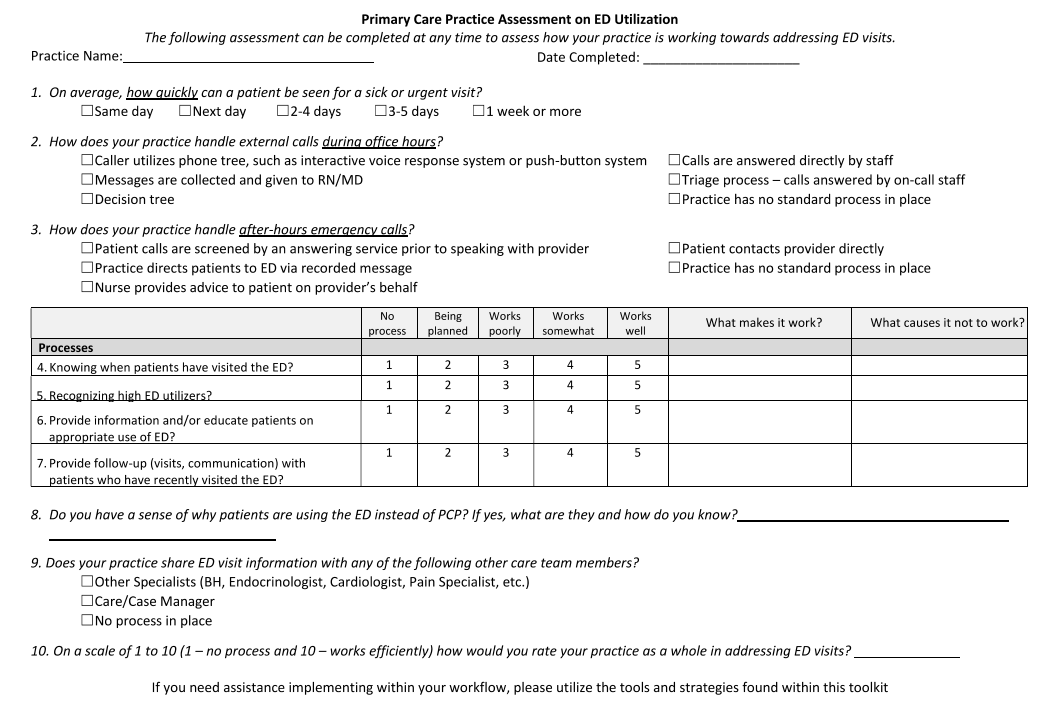
- Primary Care Practice Assessment on Emergency Department (ED) Utilization.